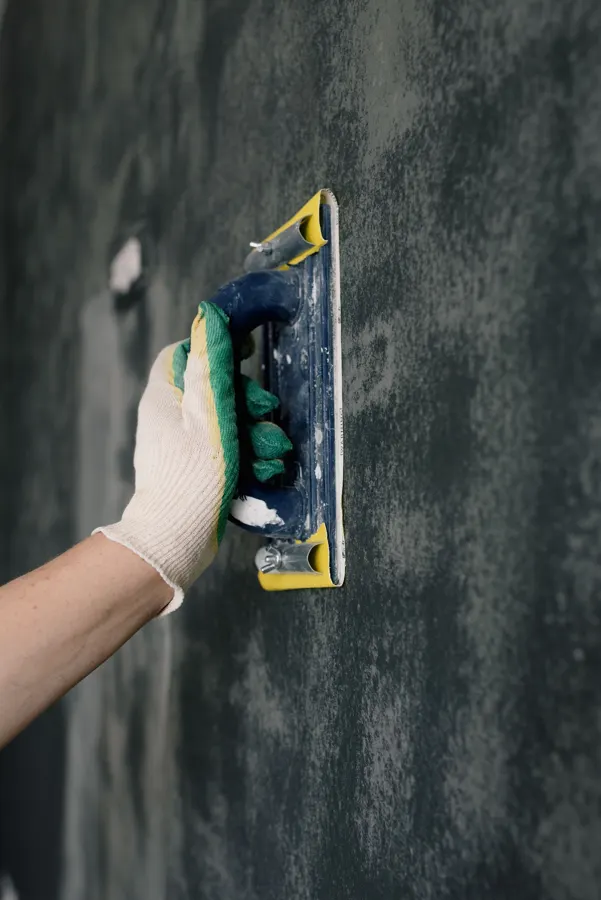
The textures you'll find in Temple homes
- **Knockdown.** Splatters of compound sprayed on and flattened with a wide knife. It's the most common wall and ceiling texture in Central Texas houses.
- **Orange peel.** Fine bumps like the skin of an orange. Common in newer homes and bathrooms.
- **Skip trowel.** A hand-troweled look with flat patches and smooth gaps. Often seen in custom and older homes.
- **Smooth.** No texture. Needs a higher finish level to look right.
- **Popcorn.** Older ceiling texture. See [popcorn ceiling removal](/popcorn-ceiling-removal-temple-tx/).
How a texture match works
- **Read the wall.** Look at splatter size, how flat the knockdown is and how far apart the drops are.
- **Test.** A small sample on cardboard or a hidden spot to set the mix and spray pressure.
- **Apply.** Spray or hand-apply over the primed patch, working the edges into the old texture.
- **Knock down.** Flatten at the right moment. Too early smears it. Too late leaves peaks.
- **Prime and paint.** Fresh texture absorbs paint differently, so it needs primer first.
Why matches fail
- The patch wasn't primed before texture
- Splatter size or spacing didn't match
- The knockdown was done too early or too late
- Only the patch was painted, and the old paint had faded
- The texture was never feathered into the surrounding wall
Retexturing a whole room
Some homeowners want to change the look. A room can go from heavy knockdown to a lighter one, from orange peel to knockdown, or from textured to smooth. Going smooth means skim-coating the whole surface, which is more work than adding texture.
Texture after a big repair
When a large piece of wall or ceiling is replaced, it's often better to retexture the whole wall or ceiling plane. That avoids a visible edge where the new texture meets the old.
What affects the price
- Patch size compared to a full wall or room
- Wall or ceiling (ceilings take longer)
- Texture type, with skip trowel and smooth taking the most time
- Furniture moving and masking
- Primer and paint included or not
Knockdown variations
Knockdown isn't one look. Things that change it:
- **Splatter size.** Fine, medium or heavy.
- **Coverage.** Sparse drops with lots of flat wall between, or dense coverage.
- **How flat.** A light knock leaves raised mounds. A heavy knock flattens them into pancakes.
- **Direction.** Knocking strokes can leave a slight grain.
A good match copies all four.
Spray rig or hand texture
- **Hopper gun and compressor.** The usual tool for knockdown and orange peel. Pressure, nozzle size and mud thickness set the pattern.
- **Aerosol texture cans.** Fine for tiny patches. Hard to match on anything larger than a few inches.
- **Hand-troweled texture.** Skip trowel and other hand looks are done with a trowel or knife, one swipe at a time.
Testing before spraying
Experienced finishers spray test patterns on scrap board or cardboard first, adjusting pressure and mix until it looks like the wall. They also wait to see how it looks after knockdown and after it dries, because wet texture looks different from dry.
Ceilings vs walls
Ceilings in Temple homes often carry a heavier knockdown than walls. When a ceiling patch is large, retexturing the whole ceiling can blend better than trying to feather new texture into old.
Changing your home's texture
Some owners want to update the look:
- **Heavy to light knockdown.** Skim to knock down peaks, then spray a lighter pattern.
- **Popcorn to knockdown.** Scrape, repair, then spray. See [popcorn removal](/popcorn-ceiling-removal-temple-tx/).
- **Textured to smooth.** Two or more full skim coats, sanding and primer. Expect more time and dust.
Paint and texture together
New texture soaks up paint unevenly until it's primed. Even after primer, painting only the patch often leaves a visible square because the old paint has faded. Painting the full wall from corner to corner is the safest way to hide a patch.
Checklist when you call
- Wall or ceiling?
- Knockdown, orange peel, skip trowel or smooth?
- Size of the area?
- Is the paint flat, eggshell or satin?
- Do you have leftover paint?
Those five answers go a long way toward planning the job.
Why texture is so common here
Texture hides small flaws, seam lines and minor movement cracks better than a smooth wall. In a region where houses move a little with the clay soil, that's a practical advantage. It's one reason knockdown is so common in Central Texas homes.
Texture on new drywall
New board gets textured after it's finished and primed or sealed. Spraying texture straight onto raw paper and compound can lead to uneven absorption, so a coat of primer first gives a more even result.
What to send for a texture match
A close photo of the texture in good side light, a wider photo of the wall, and whether it's a wall or a ceiling. That helps plan the match before the visit.
Keeping texture consistent across a room
If several patches sit on one wall, spraying them in one session keeps the pattern even. Mixing compound to the same thickness each time and holding the hopper at the same distance from the wall also helps. When a wall has many patches, retexturing the full wall can look better than spot matching. Ask about that option if the room gets strong window light.
Questions people in Temple ask
Can you match my knockdown texture?
Yes. Knockdown is the most common texture in Temple homes, and matching it is part of most repairs.
How long does knockdown take to dry before painting?
Usually a day in a cool, dry room. Humid weather can slow it. Primer goes on once it is fully dry.
Can I go from knockdown to smooth walls?
Yes, by skim-coating the wall with thin coats of compound and sanding it flat. It takes longer than adding texture.
Is orange peel or knockdown better?
Neither is better. Knockdown hides more flaws. Orange peel is subtler and easier to wipe clean.
Can spray-can texture match knockdown?
For very small patches, sometimes. For anything larger, a hopper gun gives a far better match.
Does texture hide cracks?
It hides small flaws and seam lines. A crack from movement will still come through unless the joint is re-taped.
Should new drywall be primed before texture?
Priming or sealing first helps texture go on evenly over paper and compound.